
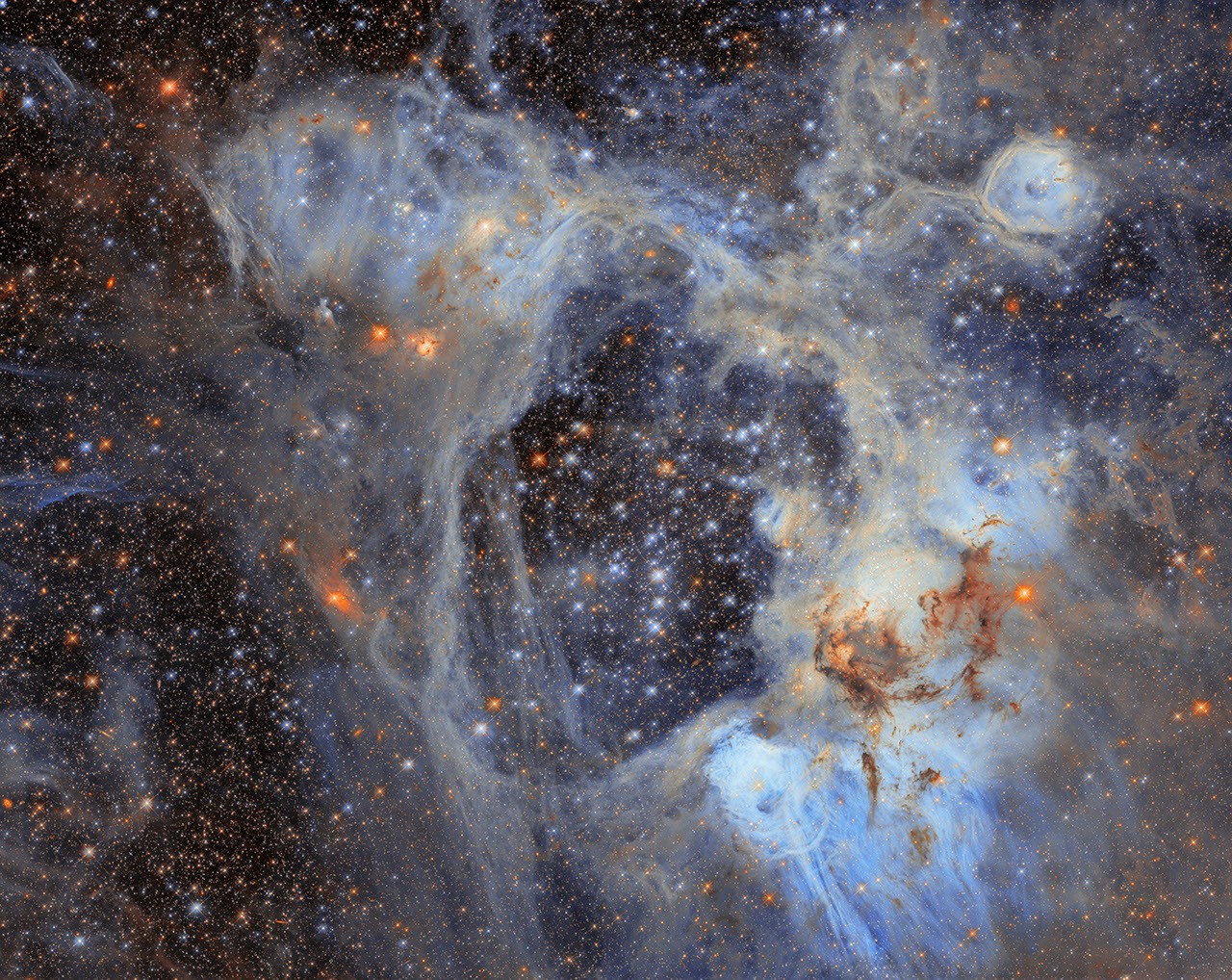
NASA Hubble Spies Superbubble
Hubble captures stunning image of nebula LHA 120-N44, a superbubble in the Large Magellanic Cloud
Introduction To The Superbubble
NASA's Hubble Space Telescope has captured a stunning image of the nebula LHA 120-N44, also known as N44, located in the Large Magellanic Cloud (LMC), the largest of the small galaxies that orbit our Milky Way galaxy. The LMC is approximately 160,000 light-years away, making it an ideal location for astronomers to study highly active star birth sites. The nebula N44 is dominated by two main features: a large central void, known as a "superbubble," and an outer shell made of dense, dusty gas.
Formation Of The Superbubble
The central void, or superbubble, spans about 210 by 140 light-years across and was created by the powerful stellar winds and explosive supernovae from the glittering stars at the center. These stars expelled much of the gas from which they were born, which then compressed and formed a shell around the superbubble. The shell surrounding the superbubble is energized by ultraviolet radiation from massive stars, causing it to glow and highlighting several distinct features. One of these features is a smaller bubble, cataloged as N44F, which is an interstellar bubble blown by the intense stellar winds of a single hot and massive star.
Astronomical Significance
N44 is an interesting target for astronomers, who are using the nebula to study how stars form in this type of cosmic environment. Their goal is to understand how long it takes from the collapse of cold gas clouds into dense knots to the moment nuclear fusion ignites in the heart of a newborn star. The data used to capture the image of N44 is from an observing program that used Hubble to survey the nebula and take a census of its stars, cataloging nearly half a million stars within the cluster, as well as interlopers drifting in front of it. Of the stars surveyed, nearly 30,000 are pre-main-sequence stars, which have yet to begin fusing hydrogen into helium in their cores.
Star Formation In The Superbubble
The gas shell surrounding the superbubble is where new stars are forming, making N44 an ideal location to study star formation. The high sensitivity and fine spatial resolution of Hubble's instruments allow astronomers to pick out faint objects in crowded clusters, including the pre-main-sequence stars. These young stars have not begun to fuse hydrogen into helium in their cores and are still in the early stages of formation. The study of N44 and its superbubble provides valuable insights into the process of star formation and the role of massive stars in shaping their surroundings.
Future Research Directions
The study of N44 and its superbubble is an ongoing area of research, with astronomers continuing to analyze the data from the Hubble Space Telescope. Future research directions may include further study of the pre-main-sequence stars and their role in the formation of new stars. Additionally, the study of the superbubble and its surroundings may provide insights into the formation and evolution of galaxies. The Hubble Space Telescope's highly sensitive instruments and fine spatial resolution make it an ideal tool for studying the complex and dynamic processes involved in star formation.
Sources
This is an original synthesis by Qivorane based on reporting from the outlets below.