
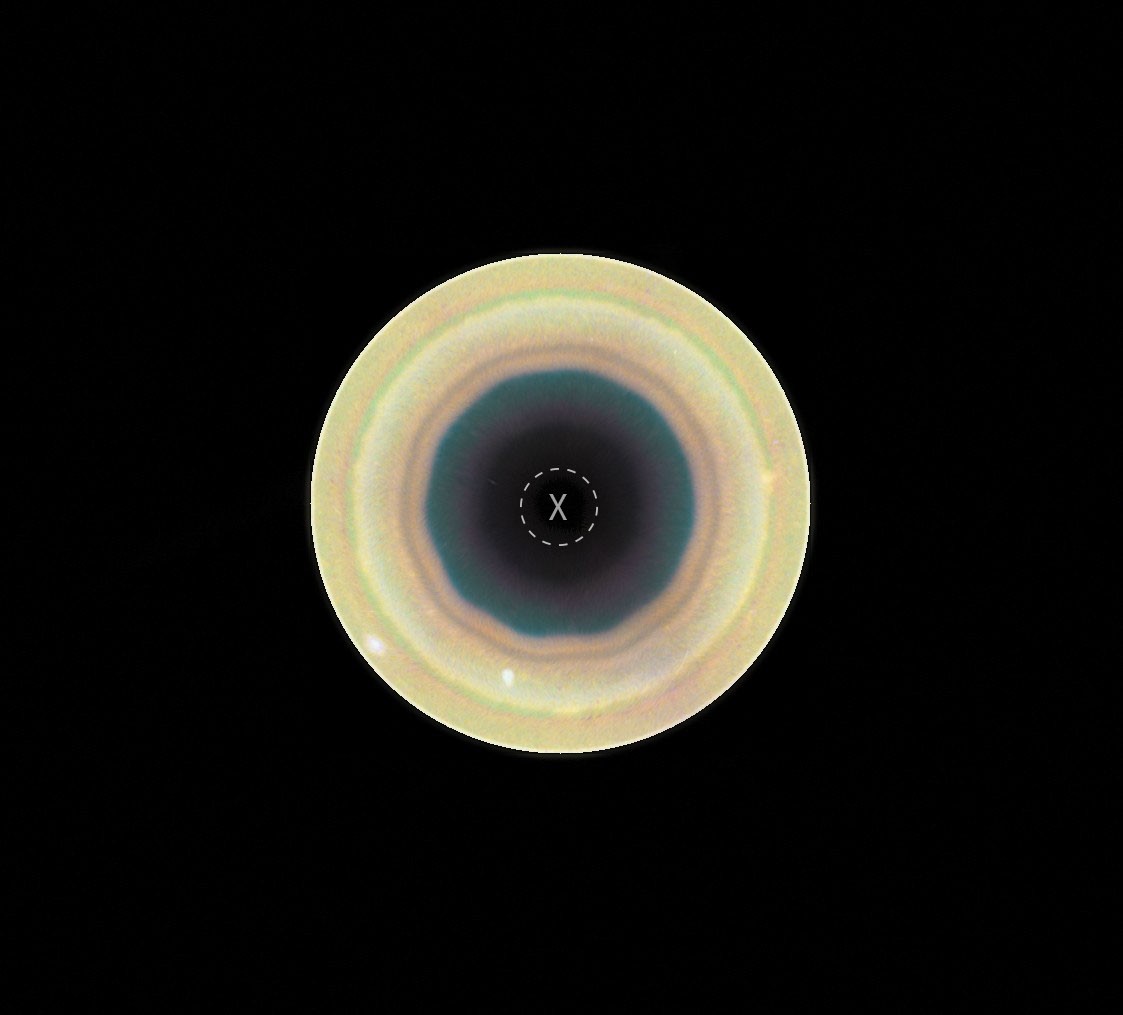
Saturn's Decagon
Hubble Space Telescope reveals decagonal cloud pattern around Saturn's South Pole
Introduction To Saturn's Geometric Poles
Saturn, the sixth planet from the Sun, has long been a subject of fascination for astronomers and space enthusiasts alike. One of the most intriguing features of Saturn is the geometric shape of its poles. The North Pole has been known to be surrounded by a hexagonal cloud pattern since its discovery in 1987 by NASA's Voyager spacecraft. Recently, the Hubble Space Telescope has made a new observation that reveals a decagonal cloud pattern around Saturn's South Pole.
Background And Discovery
The hexagonal cloud pattern around Saturn's North Pole was first discovered in 1987, and it has been found to be remarkably stable, persisting for over 40 years. The geometric boundaries of this pattern are thought to be caused by waves that form when fast-moving gas away from the poles interacts with slower-moving gas closer to the poles. This interaction creates a unique and stable wave pattern that gives rise to the hexagonal shape. The discovery of a similar geometric pattern around the South Pole, however, has raised new questions about the stability and formation of these patterns.
Observations And Findings
The recent observations of Saturn by the Hubble Space Telescope have revealed a decagonal cloud pattern around the South Pole. The decagon appears most prominent in the dark inner regions of the pole and is surrounded by bands of circulating clouds. The image composite, taken last year, marks the South Pole with an X and provides a clear view of the decagonal pattern. The stability of this pattern, however, is still a topic of research, and scientists will be monitoring it closely to see if it persists over time like the northern hexagon.
Real-World Implications And Future Research
The discovery of the decagonal cloud pattern around Saturn's South Pole has significant implications for our understanding of the planet's atmosphere and weather patterns. The geometric shape of the poles is thought to be related to the planet's rotation and the interaction between different layers of the atmosphere. Further research on this phenomenon could provide valuable insights into the dynamics of Saturn's atmosphere and the formation of similar patterns on other planets. The Hubble Space Telescope will likely continue to play a crucial role in monitoring the stability of the southern decagon and exploring the mysteries of Saturn's geometric poles.
Conclusion And Future Outlook
The discovery of the decagonal cloud pattern around Saturn's South Pole is a significant finding that highlights the complexity and beauty of our solar system. As scientists continue to study this phenomenon, they may uncover new insights into the dynamics of Saturn's atmosphere and the formation of geometric patterns on other planets. The Hubble Space Telescope has once again proven itself to be a powerful tool for exploring the wonders of our universe, and its continued observations of Saturn will likely reveal even more secrets about this fascinating planet.
Sources
This is an original synthesis by Qivorane based on reporting from the outlets below.