
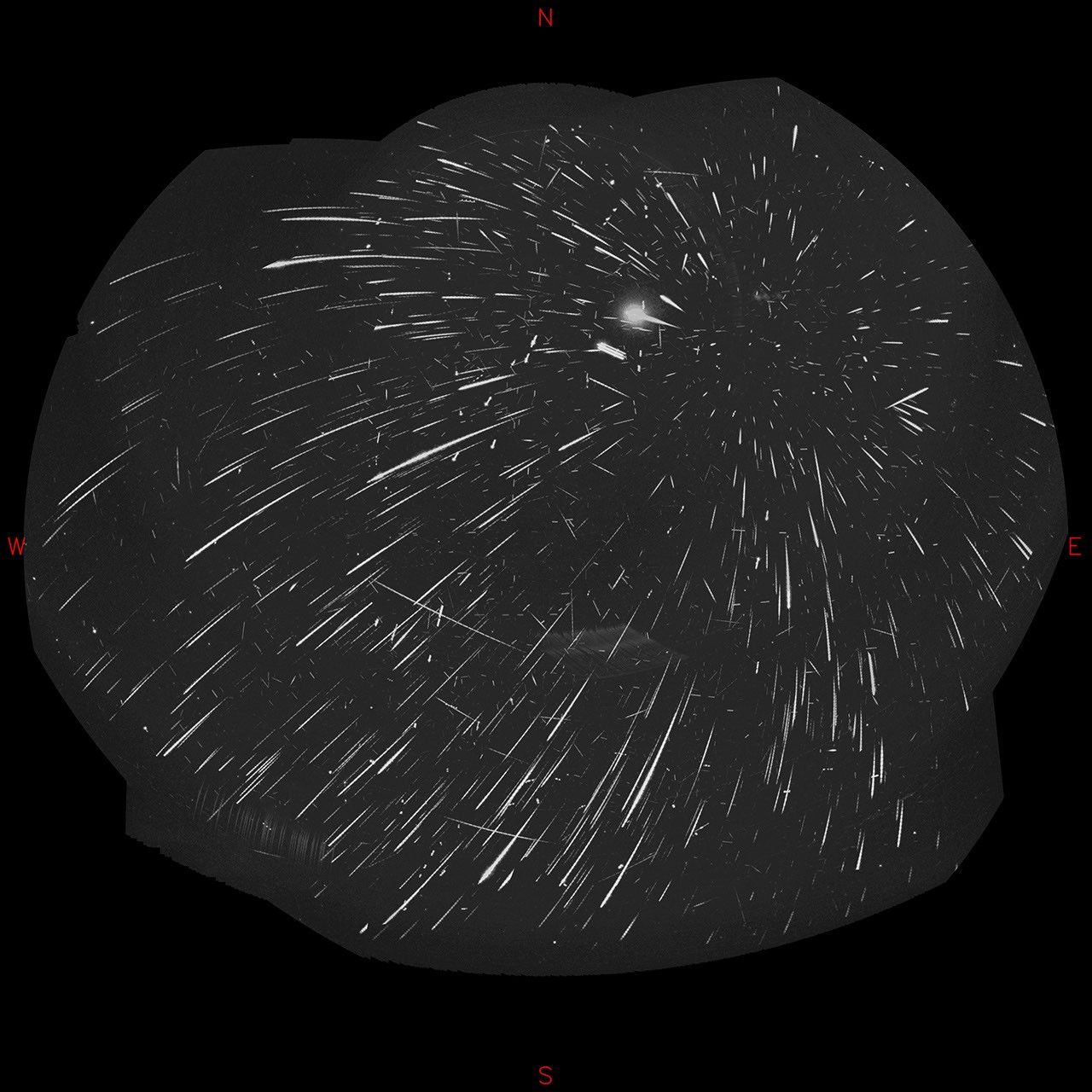
Perseid Meteor Shower
Astronomers capture stunning images of Perseid Meteor Shower
Introduction To Meteor Showers
Meteor showers have long fascinated humans, with their fleeting, fiery trails lighting up the night sky. One of the most popular and spectacular meteor showers is the Perseid Meteor Shower, which peaks in mid-August every year. This year, astronomers at an astronomical observatory in Czechia captured a stunning all-night, all-sky view of the meteor shower, revealing the overwhelming numbers of Perseid meteors and the presence of other, less active showers.
Capturing The Perseid Meteor Shower
The images were recorded on the night of August 12-13 using four dedicated meteor-monitoring cameras. By aligning and combining the images, the astronomers created a comprehensive view of the night sky, showing a total of 1,706 meteors. The majority of these meteors are Perseids, which are easy to spot due to their high numbers. The Perseid trails all trace back to a single radiant in the constellation Perseus, located in the upper right region of the sky.
Identifying Other Meteor Showers
While the Perseid Meteor Shower is the most prominent, the images also reveal the presence of other, less active showers. For example, meteors from the Kappa Cygnid shower, whose radiant lies in the constellation Cygnus, can be seen crossing the Perseid trails. Additionally, the antihelion complex, a region near Aquarius and opposite the Sun in the sky, is identifiable as a weak source of meteors. These findings demonstrate the complexity and diversity of meteor showers, highlighting the need for continued observation and study.
Real-World Implications And Future Outlook
The study of meteor showers like the Perseid Meteor Shower has significant implications for our understanding of the solar system and the formation of our planet. By analyzing the trajectories and composition of meteors, scientists can gain insights into the origins of our solar system and the potential risks posed by asteroid and comet impacts. Furthermore, the development of advanced meteor-monitoring technologies, such as the cameras used in this study, will continue to enhance our ability to detect and track meteors, providing valuable data for future research and exploration.
Conclusion And Future Research Directions
In conclusion, the Perseid Meteor Shower is a spectacular and fascinating phenomenon that continues to captivate astronomers and the general public alike. The recent study from the astronomical observatory in Czechia provides a unique glimpse into the shower's activity and composition, highlighting the presence of other, less active showers. As we continue to explore and study the solar system, the analysis of meteor showers will remain an essential component of our understanding of the universe, with potential applications in fields such as planetary defense and space exploration.
Sources
This is an original synthesis by Qivorane based on reporting from the outlets below.