

Mars Thermal Anomaly
Researchers discover thermal anomaly beneath Mars' south pole
Introduction To Thermal Anomalies On Mars
Researchers have made a groundbreaking discovery of a thermal anomaly deep beneath the surface of Mars, specifically in the southern hemisphere. This finding, led by Caltech alumnus Alexander Berne, suggests that the southern interior of Mars is approximately 200 to 400 degrees Celsius warmer than the northern half and is partially molten. The study, published in the journal Nature, utilized gravitational measurements from three Mars missions to infer the structure of the planet's interior.
Understanding Mars Through Gravity Measurements
The team used a technique called tidal tomography to measure the gravitational forces exerted by the sun on Mars over seasonal timescales. By analyzing the variations in the spacecraft's velocities, they were able to reconstruct the gravitational field around Mars and infer the planet's interior structure. This method allowed the researchers to determine the three-dimensional intricacies of Mars' interior, providing a blueprint for future missions and scientific exploration. 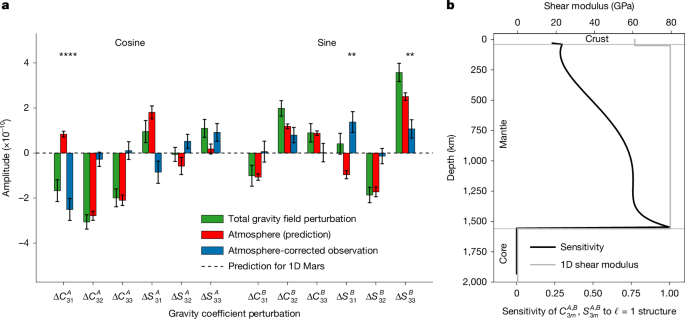
Thermal Asymmetry And Its Implications
The discovery of the thermal anomaly in the southern hemisphere has significant implications for our understanding of Mars' history and potential habitability. The thermal asymmetry could explain the magnetic anomalies found in iron minerals in the south, as well as the quicker dissipation of seismic waves in the region. Additionally, the thermal anomaly could have influenced the hydrology of Mars, including the formation of basins that may have held water. The fact that the southern hemisphere is hundreds of degrees hotter than the north suggests that a magnetic field may have existed, causing magnetic differences between the two hemispheres.
Comparing Findings And Future Research Directions
The study's findings are consistent with previous research, including NASA's InSight mission, which discovered that seismic waves dissipate more quickly in the south. The thermal anomaly could be the result of regional mantle convection or insulation by the thick southern highlands crust, which has persisted over several billion years. Further research is needed to fully understand the implications of this discovery and to determine the exact causes of the thermal anomaly. 
Conclusion And Future Outlook
The discovery of the thermal anomaly beneath Mars' south pole has significant implications for our understanding of the planet's history and potential habitability. The study's findings highlight the importance of continued research and exploration of Mars, including the use of tidal tomography and other techniques to better understand the planet's interior structure. As we continue to explore and study Mars, we may uncover even more surprising discoveries that challenge our current understanding of the Red Planet. 
Sources
This is an original synthesis by Qivorane based on reporting from the outlets below.