
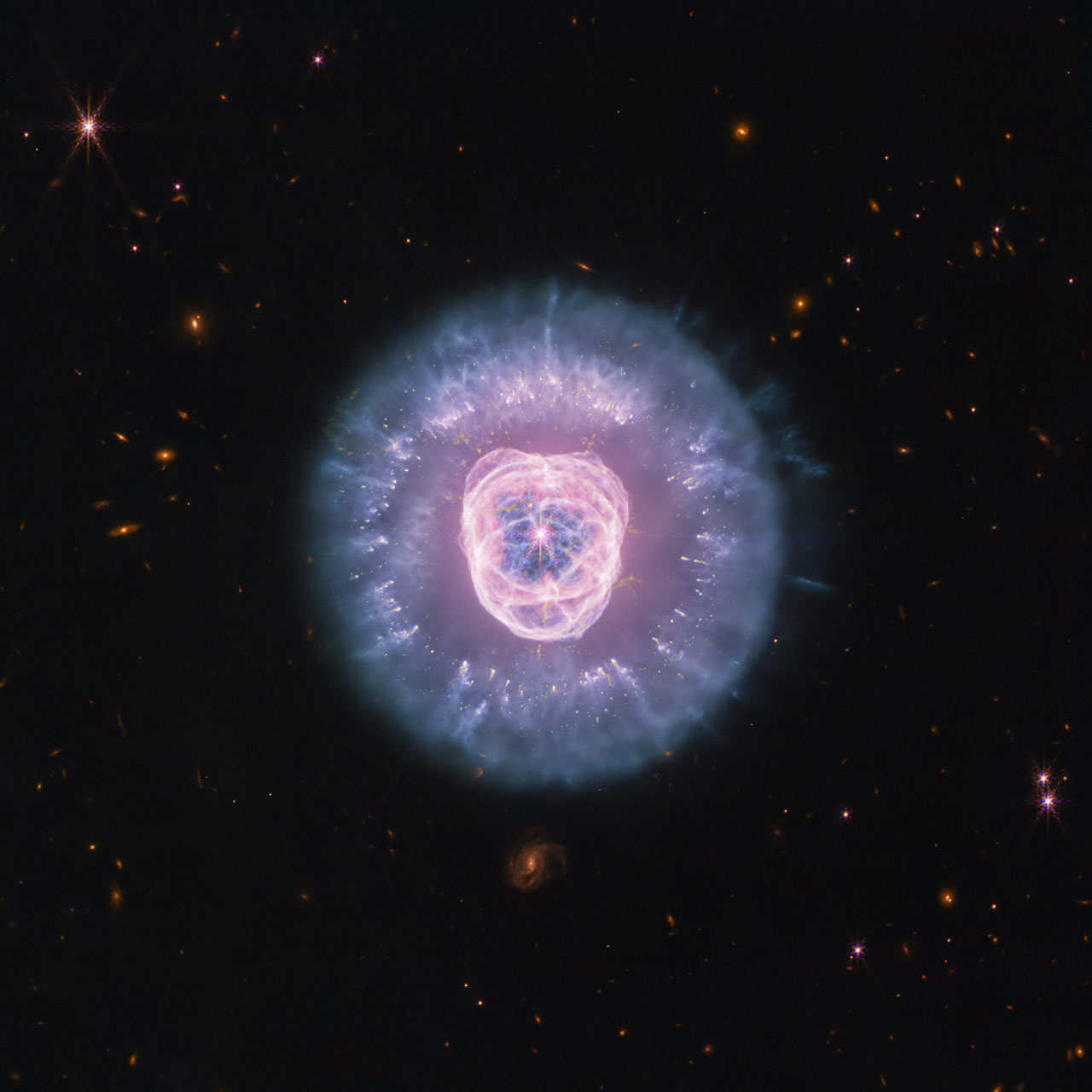
JWST Captures Lion's Head Nebula
James Webb Space Telescope images the Lion's Head Nebula, a planetary nebula formed from a Sun-like star
Introduction To The Lion's Head Nebula
The James Webb Space Telescope has captured a stunning composite image of the Lion's Head Nebula, a planetary nebula that is the remnant of a Sun-like star. This image, taken with the NIRCam and MIRI instruments, provides a detailed view of the nebula and its various components. The Lion's Head Nebula, also known as NGC 2392, is a fascinating object that offers insights into the life cycle of stars and the formation of planetary nebulas.
The Life Cycle Of A Sun-Like Star
A Sun-like star, like our own Sun, goes through various stages of evolution. As it ages, the star eventually runs out of fuel in its core and can no longer sustain the nuclear fusion needed to remain stable. At this point, the star begins to shed its outer layers, forming a planetary nebula. The hot stellar core that is left behind is called a white dwarf, which is incredibly dense and hot. The intense radiation emitted by the white dwarf ionizes the surrounding gas, creating the intricate structures seen in the Lion's Head Nebula.
Components Of The Lion's Head Nebula
The Lion's Head Nebula is composed of several distinct components. The white dwarf is located at the center of the nebula, within the "nose" of the lion. The intense radiation from the white dwarf is ionizing the gas, creating an irregular bubble that makes up the lion's "face". The "mane" of the lion is formed by dust clumps that have survived the white dwarf's radiation and a cloud of ionized gas. These components are all visible in the stunning image captured by the James Webb Space Telescope.
Implications For Our Understanding Of The Universe
The study of the Lion's Head Nebula and other planetary nebulas can provide valuable insights into the life cycle of stars and the formation of our universe. By examining the interactions between the gas, dust, and white dwarf radiation, scientists can gain a better understanding of the complex processes that shape the universe. The James Webb Space Telescope's image of the Lion's Head Nebula is an important contribution to this field of study, offering a detailed and nuanced view of this fascinating object.
Future Research Directions
The image of the Lion's Head Nebula captured by the James Webb Space Telescope is just the beginning of a new era of research into planetary nebulas. As scientists continue to study this object and others like it, they will gain a deeper understanding of the life cycle of stars and the formation of our universe. Future research directions may include the study of the interactions between the gas, dust, and white dwarf radiation, as well as the examination of the properties of the white dwarf itself. By continuing to explore and study objects like the Lion's Head Nebula, scientists can expand our knowledge of the universe and its many mysteries.
Sources
This is an original synthesis by Qivorane based on reporting from the outlets below.