
Moon Occults Venus In Daytime Eclipse
Rare celestial event where Moon occults Venus, visible to 10% of Earth during daytime
Introduction To A Rare Celestial Event
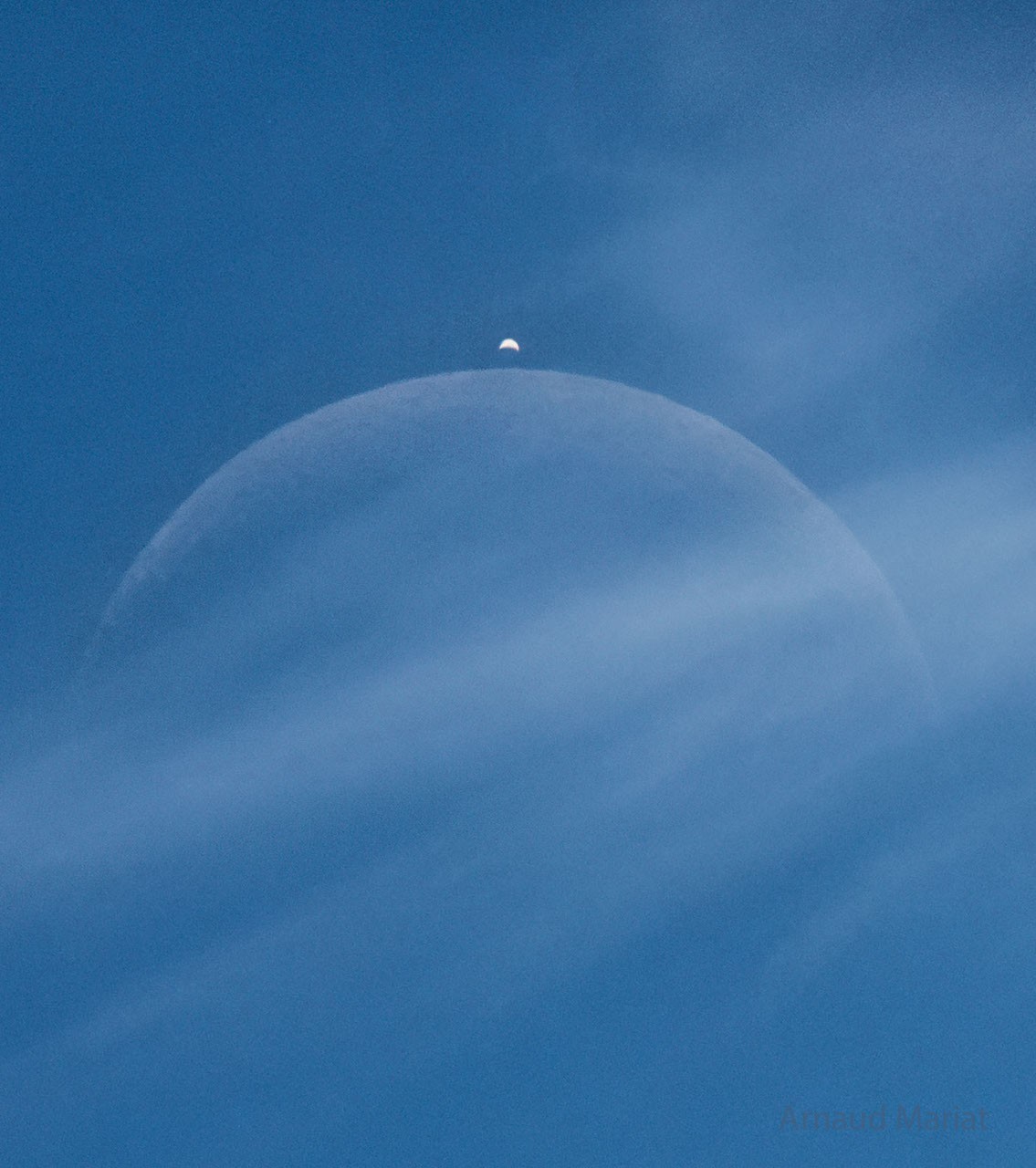
A rare and awe-inspiring celestial event occurred on September 15, 2026, when the Moon occulted Venus, creating a unique daytime eclipse. This phenomenon was visible to only about 10 percent of the Earth, with most of those able to witness it experiencing daytime. The event was captured in a single exposure by Arnaud Mariat, showcasing both the Moon and Venus in crescent phases.
Understanding The Celestial Alignment
The Moon's crescent was quite slight, with only about 10 percent of its face illuminated by the Sun. In contrast, Venus's crescent was more full, showing about 25 percent illumination. This difference in illumination is due to Venus being nearer the Sun and having more reflective clouds compared to the dark lunar surface. As a result, Venus appeared brighter in the image. The alignment of the Moon and Venus in this event allowed for a fascinating observation of their relative positions and brightness.
Capturing The Occultation
The featured exposure was taken above the small village of Cessy, France, around noon. Initially, the Moon was hard to see behind the clouds, but as the occultation began, a bright dot suddenly appeared from behind the Moon - the planet Venus, far in the distance. The image provides a unique glimpse into the celestial mechanics at play during this event. The fact that most of the area where the occultation was visible experienced daytime made the observation even more remarkable.
Implications And Accessibility
Occultations of Venus by the Moon are relatively rare and offer valuable opportunities for astronomers to study the celestial bodies involved. However, the visibility of such events is limited, covering only a small portion of the Earth's surface. The fact that this occultation was visible to about 10 percent of the Earth, mostly during daytime, highlights the unique conditions required for such an event to be observable. The image and data from this event will contribute to our understanding of the Moon and Venus, their orbits, and their interactions with the Sun.
Conclusion And Future Outlook
The daytime eclipse of September 15, 2026, where the Moon occulted Venus, is a significant celestial event that offers insights into the solar system's dynamics. As our understanding of celestial mechanics and astronomical phenomena grows, so does our ability to predict and study such events. The documentation of this occultation, including the featured image, will be valuable for future research and education, inspiring further exploration of our solar system and the wonders it holds.
Sources
This is an original synthesis by Qivorane based on reporting from the outlets below.