
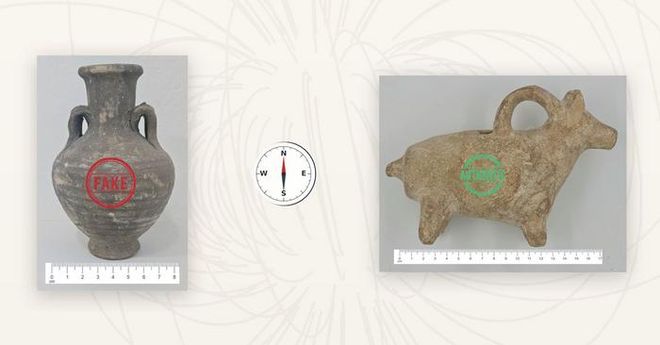
Ancient Pottery Authentication
Scientists develop new method to detect forgeries using magnetic signatures
Introduction To Ancient Pottery Authentication
Ancient pottery has long been a subject of fascination, with many artifacts being highly valued for their historical significance. However, the rise of forgeries has made it increasingly difficult to distinguish between genuine relics and clever replicas. A recent study published in PNAS has identified a novel method for authenticating ancient pottery, utilizing the Earth's shifting magnetic field to detect the age of an artifact. By measuring how heat affects the magnetic signatures trapped in ancient pottery, researchers have developed a promising tool for exposing forgeries.The Science Behind Magnetic Signatures
When raw clay is baked in a kiln, the magnetic signals of its mineral particles align with the Earth's magnetic field at that moment. As the clay cools, the signals of the larger particles remain trapped in that direction, a state known as thermal remanent magnetism. However, the smaller particles never truly settle, continually shifting alongside the planet's changing magnetic field over centuries to create what scientists call viscous remanent magnetism. This secondary magnetic noise can be wiped away by reheating the artifact, and the newer the pot, the lower the heat required to reset it.
Distinguishing Authentic Artifacts From Forgeries
To test this concept, the research team collected an array of clay objects, ranging from authentic millennia-old artifacts to cheap souvenirs and confirmed fakes. They placed the samples in an oven, raising the heat from 122 degrees Fahrenheit (50 degrees Celsius) in 18-degree Fahrenheit (10-degree Celsius) increments. The team discovered that if an artifact is more than 1,000 years old, its viscous magnetism can only be erased at temperatures above 234 degrees Fahrenheit (112 degrees Celsius). Modern ceramics lose that magnetic memory at much lower temperatures, exposing recent fabrications.
Real-World Implications And Future Outlook
The thermal threshold provides a game-changing tool for the global fight against the black-market antiquities trade. Museums worldwide can now test artifacts of disputed origins before putting them on public display, ensuring that history enthusiasts see authentic heritage rather than high-end trickery. Beyond gallery walls, the technique offers concrete scientific proof for law enforcement and legal teams prosecuting illicit looting rings and art forgery cases in court. As study lead Yoav Vaknin noted, "I hope that our new method will be useful for museum curators, who wish to display only authentic artifacts, for archaeologists and historians studying the societies which created them, and for law enforcement authorities in their effort to eliminate illicit antiquities trade."Conclusion And Future Directions
The development of this novel authentication method marks a significant step forward in the fight against art forgery. By leveraging the Earth's magnetic field, researchers have created a powerful tool for distinguishing between genuine and fake artifacts. As the technique continues to be refined and expanded, it is likely to have a profound impact on the field of archaeology and art conservation.
Sources
This is an original synthesis by Qivorane based on reporting from the outlets below.