

AI-Designed Proteins Enable RNA Transport
Researchers use AI to design proteins for efficient RNA delivery, with potential for gene editing and therapy
Introduction To AI-Designed Proteins
Researchers at the Institute of Stem Cell Research and the Institute of Developmental Genetics at Helmholtz Munich, along with the Technical University of Munich, have made a groundbreaking discovery in the field of RNA-based therapeutics. They have successfully designed and constructed an RNA transporter from the ground up using generative AI, which enables the efficient delivery of RNA into cells. This breakthrough has the potential to revolutionize the field of gene editing and therapy.
Design And Screening Of RNA Transporters
The research team combined functional protein building blocks with a structural protein designed using generative AI. This protein forms the scaffold of the vehicle and can adopt shapes that do not occur in nature. The team tested over 100 variants of the RNA transporter, with surprising results - protein structures with non-natural geometries performed particularly well. One variant, STV-C8, was found to be the most efficient, with a planar symmetry that is unusual in natural RNA transfer vehicles. 
Efficiency And Versatility Of STV-C8
STV-C8 was found to be several orders of magnitude more efficient in RNA transfer compared to natural counterparts and lipid nanoparticles (LNPs) in clinical use. The team demonstrated the versatility of STV-C8 by delivering various RNA cargoes into a wide range of cellular models. They also programmed the tropism of STV-C8 by incorporating computationally designed peptide binders, allowing it to target specific cells. 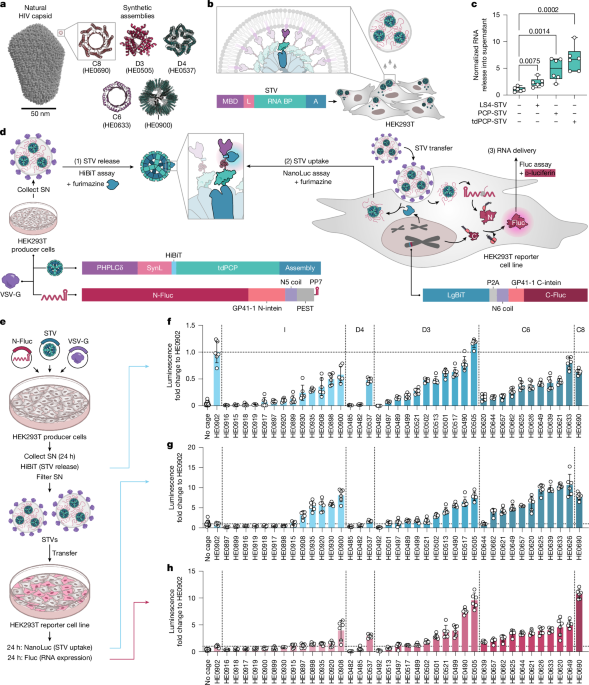
In Vivo Biodistribution And Gene Editing
The team tested the in vivo biodistribution of STV-C8 in a mouse and found that it primarily targeted the lungs. They also used STV-C8 to deliver components of the CRISPR/Cas9 system into the muscle of a pig, successfully removing a disease-relevant section of the dystrophin gene. This gene is disrupted in Duchenne muscular dystrophy, and the use of STV-C8 for gene editing has the potential to treat this disease.
Future Outlook And Implications
The discovery of STV-C8 and its potential for RNA delivery and gene editing has significant implications for the field of biotechnology. The use of generative AI to design protein structures that do not occur in nature has opened up new possibilities for the rational engineering of RNA transport systems. While further research is needed to fully realize the potential of STV-C8, the results so far are promising and could lead to the development of new therapies for a range of diseases.
Sources
This is an original synthesis by Qivorane based on reporting from the outlets below.